| 
|
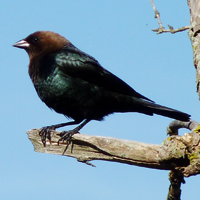
(Molothrus ater)
| Visual data presentation | Summary of means | Pairwise correlations | |
|---|---|---|---|
| Temporal | |||
| Spatial |
before reading the individual species account narrative below
Brown-headed Cowbird is a common and widespread species of open or patchy woodlands, pastures, and agricultural areas. It was very well represented in the 1992-2006 MAPS database with 3,688 adult individuals banded and 601 between-year recaptures of adults recorded at 316 stations spread across 25 Bird Conservation Regions (BCRs). Downy Woodpecker was the only other species captured in 25 BCRs, while American Robin and Common Yellowthroat were each captured in 24 BCRs. As shown in the spatial display of data, the largest numbers of adults were banded in 5 western BCRs (Northern Pacific Rainforest – BCR 5, Great Basin – BCR 9, Northern Rockies – BCR 10, Southern Rockies/Colorado Plateau – BCR 16, and Coastal California – BCR 32) and 1 eastern BCR (Eastern Tallgrass Prairie – BCR 22).
Temporal and spatial analyses of 1992-2006 MAPS data produced mean indices of adult population density for Brown-headed Cowbird (0.9 and 2.3 adults per station, respectively, from the selected models) that were quite low, only about 30% and 50% as high, respectively, as the analogous mean density indices for all landbird species included in this website. This agrees with the general idea that a parasite should be less common than its hosts. Annual variability in adult population density for Brown-headed Cowbird (11.9%) was also low, only about 50% as high as the analogous mean annual variability for all landbird species, but spatial variability in adult population density (80.3%) was very high, about twice as high as the analogous mean spatial variability for all landbird species. The linear time model for the index of adult population density produced a significantly negative Beta (-0.018 birds per station per year), suggesting a decreasing population for this species.
The weighted geometric mean of the model-averaged annual lambda estimates (0.959, which was not significantly different from 1.0) suggested a non-significantly decreasing Brown-headed Cowbird population, while the analogous mean of the BCR-specific lambda estimates (0.963, which was significantly different from 1.0) suggested a significantly decreasing population, both in agreement with the above suggestion. These estimates from MAPS also agreed qualitatively with the 1992-2006 program-wide population trend for Brown-headed Cowbird from the North American Breeding Bird Survey (BBS; a significantly decreasing lambda of 0.997). Annual variability in lambda for Brown-headed Cowbird (9.3%) was low, only about 40% as high as the analogous mean variability for all landbird species, while spatial variability (14.7%) was very high, about 2 ½ times as high as the analogous mean variability for all landbird species.
Temporal and spatial analyses produced somewhat different mean estimates for adult apparent survival for Brown-headed Cowbird (0.476 and 0.455, respectively) that were very low and perhaps deficient, especially considering its relatively heavy body mass. Because a number of MAPS stations that capture Brown-headed Cowbirds were sited in areas where active cowbird control measures were being implemented, we wonder whether the low adult apparent survival rates could reflect such control measures. Annual variability in adult apparent survival (12.4%), like annual variability in lambda, was low, only about 50% as high as the analogous mean annual variability for all landbird species, while spatial variability (15.0%) was very similar to the analogous mean variability for all landbird species.
Temporal and spatial analyses produced mean productivity indices for Brown-headed Cowbird (0.098 and 0.135, respectively, from the selected models) that were very low, only about 25% and 30% as high, respectively, as the analogous mean productivity indices for all landbird species included on the website. These low productivity indices were not necessarily deficient, because species that are nest parasites might likely be expected to have lower productivity indices than their host species. Annual variability in productivity for Brown-headed Cowbird (27.4%) was also low, only about 65% as high as the analogous mean variability for all landbird species. With low annual variability in both adult apparent survival and productivity, it was not surprising that Brown-headed Cowbird also showed low annual variability in lambda. In contrast to annual variability, spatial variability in productivity for Brown-headed Cowbird (78.5%) was quite high, about two thirds higher than the analogous mean variability for all landbird species.
Temporal analyses of Brown-headed Cowbird vital rates showed that lambda was positively correlated with productivity, post-breeding effects, and adult apparent survival, in that order of strength of correlation; none of the 3 correlations, however, was significant. These results suggest that annual variation in all three vital rates likely interacted to drive annual variation in lambda. Because annual variation in productivity tended to be a stronger driver of temporal variation in lambda than either post-breeding effects or adult apparent survival, it might be suggested that cowbird control measures, which would negatively affect adult apparent survival and post-breeding effects (i.e., first year survival and recruitment of young birds) more than they would affect productivity, have had less of an effect on lambda than more natural processes that may have affected productivity. However, considering that cowbird control measures have affected a much smaller spatial area than the area affected by natural processes, it seems likely that cowbird control measures have actually been much more effective than natural processes in driving local cowbird population declines.
Temporal analyses also showed that post-breeding effects were strongly and significantly negatively correlated with productivity, and moderately and nearly significantly negatively correlated with adult apparent survival, suggesting competitive interactions among young birds and between young and adults on the non-breeding grounds, and also, possibly, on the breeding grounds. In addition, adult apparent survival was rather weakly and non-significantly positively correlated with productivity.
Temporal analyses of Brown-headed Cowbird vital rates also showed that lambda was moderately and non-significantly negatively correlated with the index of adult population density, suggesting some degree of density dependence in Brown-headed Cowbird population regulation. Post-breeding effects were also rather strongly and significantly negatively correlated with adult population density, while both productivity and adult apparent survival were weakly and non-significantly positively correlated with population density. This suggests that density dependence in Brown-headed Cowbird was effected virtually exclusively through post-breeding effects, likely through first-year survival of young on the non-breeding grounds; or on the breeding grounds through access to females by young males, or selection of young females by older males.
Spatial correlations between lambda and other vital rates for Brown-headed Cowbird differed dramatically from temporal correlations in that lambda was moderately and significantly negatively correlated with adult apparent survival, and essentially not correlated at all with either productivity or post-breeding effects. Thus, it is not clear which vital rate(s) drove spatial variation in lambda, except to note that lambda was very strongly and very highly significantly positively spatially correlated with recruitment. It is not clear, however, exactly what drives spatial variation in recruitment for Brown-headed Cowbird or how that recruitment drives spatial variation in lambda. In addition, productivity was significantly negatively spatially correlated with both post-breeding effects and adult apparent survival, while adult apparent survival and post-breeding effects were very weakly and non-significantly positively correlated with each other.
Summary of research and management hypotheses – In general, because the Brown-headed Cowbird plays an important role in driving population declines of a number of other landbird species, particularly certain threatened or endangered species and subspecies, we suggest that research and management efforts for cowbirds should, at least locally, be tailored to maintain or enhance population declines in the species. It is encouraging, therefore, to see that both MAPS and the BBS indicate a range-wide cowbird population decline. On the other hand, there likely are areas where Brown-headed Cowbirds do not present a major threat to populations of other species, and in these areas stable populations of cowbirds should be maintained. Either way, MAPS data suggest that all three major vital rates play a positive role in driving temporal variation in lambda for Brown-headed Cowbird, with productivity and post-breeding effects (likely primarily first-year survival and subsequent recruitment of young) playing stronger roles than adult apparent survival. Because productivity of Brown-headed Cowbird involved contributions from host species, we suggest that research and management of cowbird populations, either to decrease population sizes or to maintain stable populations, should primarily be directed toward manipulating first-year survival and subsequent recruitment of young birds, and secondarily toward manipulating survival of adults. These actions could be implemented on both the breeding and non-breeding grounds by managing the species’ food supplies, including the species’ access to agriculturally-based food supplies, or by directly trapping and culling their numbers. Because optimal cowbird breeding habitat likely consists of a mosaic of woodlands with large numbers of nesting passerines and areas where domestic animals are grazed or penned, or areas with large supplies of accessible grains, effective habitat management strategies to affect cowbird populations should, at least theoretically, be possible. Finally, because management actions should be tailored to specific areas on the breeding grounds where the species presents a threat to other bird populations, and because some of the most effective management might best be carried out on the non-breeding grounds, considerable additional detailed information on migratory connectivity will be needed.
Please cite this narrative as: DeSante, D. F., D. R. Kaschube, and J. F. Saracco. 2015. Vital Rates of North American Landbirds. www.VitalRatesOfNorthAmericanLandbirds.org: The Institute for Bird Populations.