
| 
|
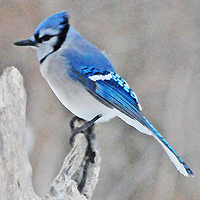
(Cyanocitta cristata)
| Visual data presentation | Summary of means | Pairwise correlations | |
|---|---|---|---|
| Temporal | |||
| Spatial |
before reading the individual species account narrative below
Blue Jay, a common and widespread species of woodlands virtually throughout eastern and central North America, was fairly well represented in the 1992-2006 MAPS database with 1,330 adult individuals banded but only 88 between-year recaptures of adults recorded at 207 stations located in 16 Bird Conservation Regions (BCRs). Only 10 of the 158 species included on this website were captured at more stations than Blue Jay. As shown in the spatial display of results, the largest numbers of adults (about 20% of the total) were banded in the New England/Mid Atlantic Coast (BCR 30), followed by the Eastern Tallgrass Prairie (BCR 22, with 16% of the total).
Temporal and spatial analyses of 1992-2006 program-wide MAPS data showed weighted mean population density indices for Blue Jay of 0.6 and 1.6 adults per station, respectively. These densities, like those for all four jay species included on this website, were low, only about 20% and 45% as high, respectively, as the analogous mean density indices for all species on the website. These low indices not only reflect a relatively low actual density of birds, but also the difficulty of capturing these relatively large-bodied birds in the fine mesh mist nets employed in the MAPS program. Both annual and spatial variabilities in population density (15.3% and 24.1%, respectively) were low, about 35% and 40% lower, respectively, than the analogous mean variabilities for all species. The linear time model for the index of adult population density produced a significantly negative Beta of -0.020 adults per station per year, suggesting a decreasing population for Blue Jay.
The weighted geometric mean of the model-averaged annual lambda estimates (0.969, which was not significantly different from 1.0) suggested a non-significantly decreasing population for Blue Jay, but the geometric mean of the model-averaged BCR-specific lambda estimates (0.964, which was significantly different from 1.0) suggested a significantly decreasing population. These estimates agreed with the significantly decreasing index of population density suggested above, as well as the population trend from the 1992-2006 program-wide North American Breeding Bird Survey (BBS; a lambda of 0.992 that was significantly different than 1.0) that also indicated a significantly decreasing population. The annual variability of lambda for Blue Jay (10.1%) was low, only about 44% as high as the analogous mean variability for all species, while spatial variability of lambda (7.2%) was somewhat high, about 30% higher than the analogous mean variability for all species.
Temporal and spatial analyses produced model-averaged estimates for adult apparent survival for Blue Jay (0.670 and 0.671, respectively) that were very similar to each other and about as expected, or maybe slightly higher than expected, considering the body mass of the species (the fifth heaviest of the 158 species on the website) as compared to the body masses of all other 157 species. This suggests that adult apparent survival for Blue Jay was likely not deficient. Annual variability in adult apparent survival for Blue Jay (20.2%) was slightly low, about 15% lower than the analogous mean variability for all species, while spatial variability in adult apparent survival (8.9%) was quite low, about 43% lower than the analogous mean variability for all species.
Temporal and spatial analyses produced mean estimates of the productivity index for Blue Jay that were identical to each other (0.178 from the selected models), were substantially lower than the analogous mean estimates for all species on the website (0.384 and 0.383, respectively), and were the lowest of the four jay species included on the website. Thus, productivity for Blue Jay may well have been deficient and may have been one cause of the population declines documented by both MAPS and the BBS. Both annual and spatial variabilities in productivity for Blue Jay (30.8% and 45.0%, respectively), however, were somewhat low, about 28% and 5% lower, respectively, than the analogous mean variabilities for all species.
Temporal analyses among Blue Jay vital rates showed that lambda was moderately but not significantly positively correlated with productivity, and weakly and non-significantly positively correlated with both post-breeding effects and adult apparent survival. These results suggest that annual variation in lambda was relatively weakly driven by annual variation in all three vital rates, but most strongly by annual variation in productivity. Post-breeding effects were also very strongly and highly significantly negatively correlated with adult apparent survival, suggesting considerable potential competition between adult and young birds that likely affected the survival of young birds on the non-breeding grounds, as well as likely affecting the subsequent recruitment of the surviving young on the breeding grounds. In addition, both post-breeding effects and adult apparent survival were weakly and non-significantly negatively correlated with productivity, suggesting a possible weak level of competition among young birds and, perhaps, among adults as well.
Temporal analyses also showed that lambda was rather strongly and significantly negatively correlated with the index of adult population density, suggesting that the population dynamics of Blue Jay were rather strongly effected in a density-dependent manner. In addition, post-breeding effects were also moderately but not significantly negatively correlated with population density, while adult apparent survival was moderately and non-significantly positively correlated with population density, and productivity was essentially not correlated at all with population density. These results suggest that density-dependence in Blue Jay was brought about through post-breeding effects, that is, through first-year survival and subsequent recruitment of young. These results also indicate that the vital rate whose annual variations were the major driver of annual variation in lambda (productivity) was not the vital rate through which density dependence was primarily effected (post-breeding effects), a relatively common situation among landbird species, especially among migratory species. Interestingly, this situation for Blue Jay, a partially migratory species, was opposite to the situations for both Steller’s Jay and Western Scrub-Jay, which are both permanent resident species.
Spatial analyses showed that lambda was strongly and significantly positively correlated with post-breeding effects, and essentially not correlated at all with either adult apparent survival or productivity. These results suggest that spatial variation in lambda was driven entirely by spatial variation in post-breeding effects, which likely reflected spatial variation in first-year survival of young, or in recruitment of surviving young, or both. Post-breeding effects were also very strongly and highly significantly negatively correlated with productivity, and strongly and significantly negatively correlated with adult apparent survival, suggesting likely competition both among young birds and between young and adult birds. This competition likely affected both the survival of young birds on the non-breeding grounds and the recruitment of surviving young on the breeding grounds. As perhaps expected from these latter two correlations, adult apparent survival was rather strongly but non-significantly positively correlated with productivity.
Summary of research and management hypotheses – Although Blue Jay is common and widely distributed across its range in eastern North America, and often considered to have a negative influence on populations of other landbird species, the population declines shown by both MAPS and the BBS suggest that research and management efforts to reverse the declines and maintain stable populations may be warranted. Because of the apparently low and deficient overall productivity for Blue Jay, we suggest that research and management first be directed toward determining and managing for habitat and environmental characteristics that promote higher levels of productivity, especially during years when productivity is low and appears to be the most important driver of population declines. Second, because first-year survival of young or subsequent recruitment of young appears to be the major driver of spatial variation in lambda, we suggest that research and management should also aim to determine and manage for habitat and other environmental characteristics associated with higher levels of both survival of young during the non-breeding season and recruitment of young during the subsequent breeding season, especially within regions where post-breeding effects are low and appear to drive declines in lambda. Because migration patterns in Blue Jay are very poorly understood, we suggest that additional information on migratory connectivity for the species is needed. Finally, because both productivity and survival and recruitment of young are likely to be strongly affected by weather conditions, and because those weather conditions are likely to be strongly affected by climate change, we suggest that the research and management efforts outlined above should include considerations of both weather and climate change.
Please cite this narrative as: DeSante, D. F., D. R. Kaschube, and J. F. Saracco. 2015. Vital Rates of North American Landbirds. www.VitalRatesOfNorthAmericanLandbirds.org: The Institute for Bird Populations.