| 
|
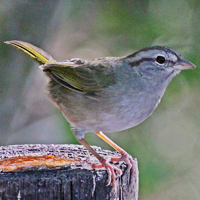
(Arremonops rufivirgatus)
| Visual data presentation | Summary of means | Pairwise correlations | |
|---|---|---|---|
| Temporal | |||
| Spatial |
before reading the individual species account narrative below
Because Olive Sparrow has a range in North America that occurs in only a single Bird Conservation Region (BCR), Tamaulipan Brushlands (BCR 36), and because it was captured at only 5 stations in that one BCR during only 12 years (1995-2006), it was rather poorly represented in the 1992-2006 MAPS database with only 269 adult individuals banded and 88 between-year recaptures of adults recorded. Because of this overall sparseness of data, especially for between-year recaptures of adults and captures of young birds, usable annual estimates of lambda, adult apparent survival, and productivity were only obtained for 10, 9, and 11 years, respectively, with only 6-9 years in common. Furthermore, because Olive Sparrow was found in only one BCR, no information was available from spatial analyses, other than time-constant estimates from that one BCR, and no spatial correlations could be obtained.
Temporal analyses of 1992-2006 MAPS data produced an extremely high mean index of adult population density for Olive Sparrow (11.8 adults per station), which was not only the highest of all 23 sparrow (Emberizidae) species (over 3 times higher than the mean for all sparrow species), but was also the highest index of adult population density from temperate analyses of all 158 landbird species included on this website. This high adult population density index was not only a result of the species’ intrinsic high density in its preferred habitat, but also likely a result of the fact that all 5 stations where the species was captured were in relatively optimal Olive Sparrow habitat. The annual variability of this index (32.6%), however, was also somewhat high, about 25% higher than the mean annual variability for all species.
The weighted geometric mean of the model-averaged annual lambda estimates (1.015, which was not significantly different from 1.0) indicated a non-significantly increasing population trend. This estimate agreed fairly well with the Olive Sparrow’s 1992-2006 population trend from the North American Breeding Bird Survey (BBS; a significantly increasing lambda of 1.039). Annual variability in MAPS lambda (CV = 20.2%) was about 10% lower than the analogous mean variability for all sparrow species.
Temporal analyses produced a mean estimate for adult apparent survival for Olive Sparrow (0.563) which was quite high considering its body mass, and was especially high considering the adult apparent survival rates and body masses of other sparrow species. Indeed, among all sparrow species, only Green-tailed Towhee, California Towhee, and Savannah Sparrow showed higher adult apparent survival rates relative to their body masses than Olive Sparrow, whose high adult apparent survival rate was likely a result of its permanent resident (non-migratory) life history strategy and its year-round range in a warm, subtropical climate. As perhaps expected from its range, annual variability in adult apparent survival for Olive Sparrow (15.6%) was low, about 30% lower than the analogous mean variability for all sparrow species.
Temporal analyses produced a mean reproductive index for Olive Sparrow (0.260) that was among the lowest of sparrow species and over 50% lower than the mean for all sparrow species. The pattern shown by Olive Sparrow of low productivity and high survival was perhaps typical of subtropical permanent resident species and, interestingly, was also shown by Long-billed Thrasher, another permanent resident species which shares the Olive Sparrow’s habitat and North American range. Surprisingly, however, annual variability in productivity for Olive Sparrow (100.2%) was, along with Clay-colored Sparrow, the highest of all sparrows, about twice as high as the analogous mean annual variability for all sparrow species.
Temporal analyses among Olive Sparrow vital rates showed that lambda was moderately but not significantly positively correlated with productivity, weakly and not significantly positively correlated with adult apparent survival, and very weakly positively correlated with post-breeding effects. A very strong and significant negative correlation was found between productivity and post-breeding effects, but essentially no correlations at all existed between adult apparent survival and either productivity or post-breeding effects. These results suggest that annual variation in lambda was driven to some extent by all three vital rates, but primarily by productivity; and that when productivity was high, first-year survival of young birds and/or subsequent recruitment of the surviving young was low, likely because of competition among young birds.
Temporal analyses also showed that lambda was moderately but not significantly negatively correlated with the index of adult population density, suggesting that at least some amount of density dependence was likely involved in the population regulation of Olive Sparrow. In addition, adult population density was rather strongly negatively correlated with productivity, strongly positively correlated with post-breeding effects, and moderately positively correlated with adult apparent survival. None of these three correlations, however, was significant, likely because of the relatively small numbers of years (6-8) involved in the correlations. These results suggest that the density dependence shown by Olive Sparrow populations was effected virtually entirely through productivity. Moreover, they indicate that the vital rate through which density-dependent population regulation was effected (productivity) was the same vital rate that was the primary driver of temporal variation in lambda. This pattern of relationships among vital rates was relatively uncommon among North American landbirds, but perhaps was a more common pattern among subtropical or tropical permanent resident species.
Summary of research and management hypotheses – The rather limited data from MAPS for Olive Sparrow, but the relatively consistent results they produced, suggest that research and management efforts to maintain the species’ stable or increasing population trend should first be directed toward determining and maintaining or enhancing the habitat types and characteristics that are associated with higher productivity, especially during years when lower productivity appears to drive population declines. Second, research and management should be directed toward determining and maintaining or enhancing the habitat types and characteristics that are associated with higher adult apparent survival and first-year survival of young, especially during years when these survival rates are low and might also be driving population declines. It is likely that considerations of weather and climate change will need to be included in these efforts in order to produce maximum conservation effectiveness.
Please cite this narrative as: DeSante, D. F., D. R. Kaschube, and J. F. Saracco. 2015. Vital Rates of North American Landbirds. www.VitalRatesOfNorthAmericanLandbirds.org: The Institute for Bird Populations.